
| | by admin | | posted on 8th August 2025 in Power to Protest | | views 48 | |
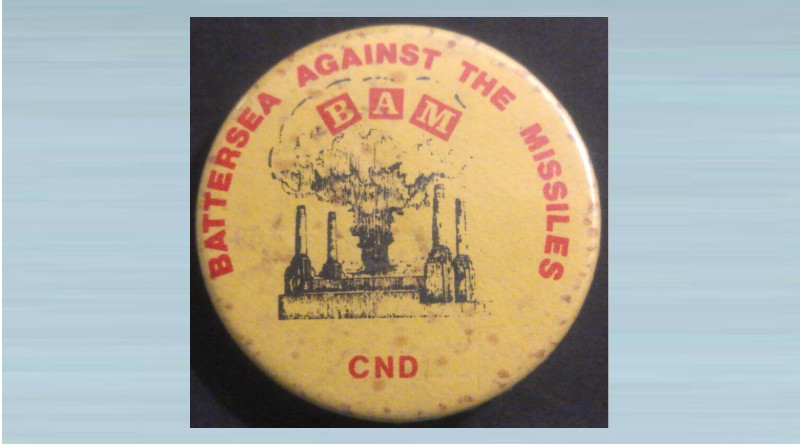
A local campaign with a national message, Battersea against the missiles (BAM) played a vital role in the grassroots energy of the Campaign for Nuclear Disarmament.
BAM was a grassroots anti-nuclear group active in the early 1980s. Based in the South London borough of Battersea, BAM formed as a direct response to the growing threat of nuclear weapons during a period of heightened Cold War tensions. It quickly became a visible and creative part of the wider Campaign for Nuclear Disarmament (CND).
While CND provided national coordination and high-profile demonstrations, BAM worked on the ground — organising local protests, community meetings and acts of civil disobedience. Its work was rooted in Battersea’s long tradition of radical politics, drawing on local networks of trade unionists, peace activists, socialists and feminists.
BAM was formed in opposition to NATO's decision to site cruise missiles in Britain — a move seen by many as a step closer to nuclear war. Like other local anti-nuclear groups, BAM believed that peace would not be achieved without mass mobilisation from below. Its members included concerned parents, students, churchgoers, artists and long-time campaigners.
Leafletting, street stalls, poster campaigns and community film nights were all part of BAM’s activity. The group often worked in alliance with nearby peace groups in South London and took part in national CND demonstrations — bringing a distinctly local identity to wider protests. Their banners, often hand-painted and spirited, carried the name “Battersea Against the Missiles” with pride.
Battersea Power Station, the iconic coal-fired structure on the Thames, loomed large both physically and symbolically over BAM's activities. Though never considered for nuclear conversion, the power station embodied the state’s control over energy and industry. It served as a stark reminder of centralised power and pollution — making it a fitting visual backdrop for protest. The idea of placing a nuclear facility in such a location was unthinkable, not only for technical reasons but because of public sentiment. Yet for BAM, the site itself was a reminder of the industrial forces tied up with militarism and the arms race.
Like many CND-affiliated groups of the time, BAM had strong involvement from women activists. Some were inspired by the feminist peace camp at Greenham Common, which had begun in 1981. BAM members visited Greenham, supported its blockades, and brought its spirit of nonviolent resistance back to their own streets.
The group also placed a strong emphasis on community education. School talks, church meetings and peace picnics helped to make the dangers of nuclear escalation a kitchen-table issue. They believed that peace was everyone’s responsibility — and that Battersea had a voice worth hearing.
Though BAM as an organisation no longer exists, its work contributed to a wider culture of local resistance that defined CND’s influence in the 1980s. Groups like BAM helped ensure that anti-nuclear sentiment was not confined to major cities or symbolic marches, but rooted in everyday life.
Some of BAM’s surviving materials - badges, banners and flyers — are now collected by peace historians and museums. They remain testament to the power of ordinary people coming together in extraordinary times.