
| | by admin | | posted on 26th November 2025 in Local Activism | | views 60 | |
Eight years of Extinction Rebellion Lincolnshire shows how a rural county has developed its own distinctive, community-rooted climate activism, blending creativity, protest and local environmental concerns.
Eight years on from its founding, Extinction Rebellion Lincolnshire has become one of the most visible and persistent expressions of grassroots climate activism in the county. Emerging in late 2018 as part of the wider Extinction Rebellion movement that surged across the UK, the Lincolnshire group brought together a diverse community of local activists under a shared banner: to demand urgent action on the climate and ecological crisis. What began as a handful of people meeting in a café off Lincoln’s Steep Hill quickly grew into a network stretching from Boston to Grimsby, and inland through Sleaford, Grantham and Gainsborough.
From the outset, XR Lincolnshire’s activism was shaped by the county’s unique geography. Lincolnshire’s long, low-lying coastline - stretching from Cleethorpes to Skegness and down towards the Wash - makes it one of the most vulnerable areas of England to sea-level rise. Many early actions highlighted flooding risk, including vigils after the devastating Wainfleet floods of 2019, when the River Steeping burst its banks and hundreds of homes were evacuated. Rebels organised banner drops on the A52 near Skegness reading “One More Flood Is One Too Many”, linking local experience to global climate impacts.
As the movement grew, Extinction Rebellion Lincolnshire became increasingly rooted in local environmental concerns. Campaigns around peatland destruction in the Witham Valley, where drained peat soils release vast amounts of carbon, helped shift discussion towards restoration and sustainable land use. Activists also engaged with the agricultural sector, recognising that Lincolnshire is one of the UK’s major farming counties. Actions outside the Lincolnshire Show acknowledged the pressures facing food producers, calling for government support for regenerative agriculture rather than blaming farmers individually.
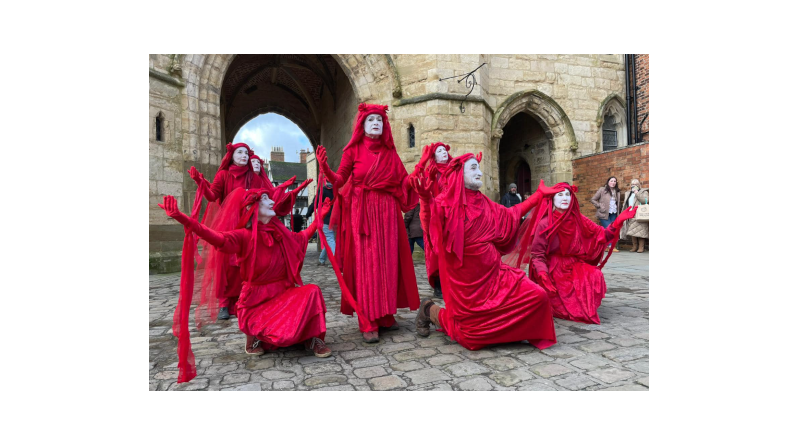
Lincoln Cathedral emerged as a symbolic focal point. Silent vigils were held on its steps during major XR national actions, and a striking “die-in” took place within the Cathedral grounds in 2019 with permission from clergy sympathetic to the group’s aims. Quaker involvement gave many of these actions a reflective tone, with Meetings for Worship held in Castle Square, blending spiritual witness with public protest.
Local government engagement became another defining feature. XR Lincolnshire played a prominent role in encouraging both Lincolnshire County Council and City of Lincoln Council to declare climate emergencies in 2019. Activists also lobbied Boston Borough Council over flood defences and coastal resilience, and protested outside North Kesteven District Council in relation to the proposed Grantham incinerator, arguing that large-scale waste-burning undermined recycling and emissions reduction.
The group also intervened in national debates with local implications, notably raising environmental concerns about the proposed use of RAF Scampton as an asylum processing site. XR Lincolnshire argued that the redevelopment risked damaging protected habitat and undermining heritage and green space campaigns already active around the former Dambusters base.
Creativity became a hallmark of the movement. Giant fish puppets appeared at Cleethorpes beach clean-ups, symbolising marine pollution; samba drummers led marches through Lincoln High Street; and colourful “discobedience” flash mobs erupted in Boston Market Place during peak shopping hours. Homemade XR badges and banners became a familiar sight at county fairs, the Lincoln Christmas Market, and even the Lincolnshire Show, helping normalise climate activism within everyday community settings.
The pandemic years marked a turning point. With street protests restricted, XR Lincolnshire adapted by hosting online climate education sessions focused on coastal defence strategies and peat restoration. Rural members who previously struggled to travel to meetings became more involved. By 2022-23, the group had returned to public action but with a renewed emphasis on community projects, including tree planting, repair cafés and collaboration with local wildlife trusts.
Eight years on, XR Lincolnshire has left a visible ongoing legacy. Councils now routinely reference climate concerns in planning decisions; coastal flooding and erosion are treated as political priorities rather than unfortunate weather; and local media report environmental stories with greater prominence. Schools across the county have adopted sustainability policies, and coastal communities increasingly frame flooding as a climate justice issue rather than an unavoidable fact of life.