| | by admin | | posted on 27th November 2025 in Quakers in 100 Objects | | views 271 | |
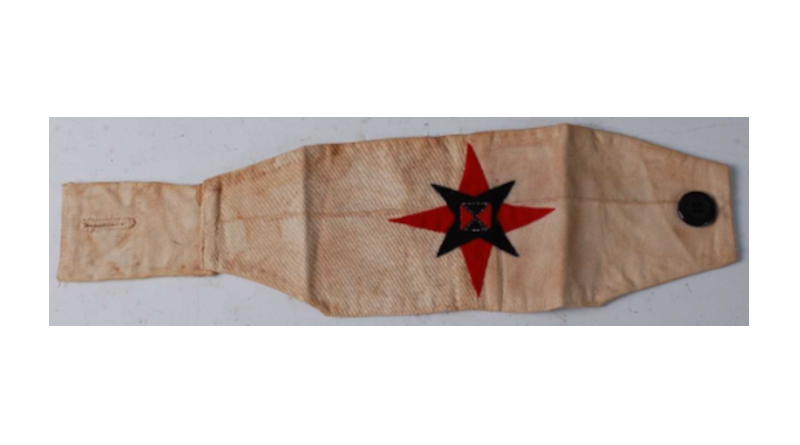
The Friends War Victims Relief armband represents the moment when Quakers first organised large-scale humanitarian action during war.
Among the most recognisable objects associated with Quaker wartime relief is the simple cloth armband marked 'Friends War Victims Relief' or later 'Friends War Relief Service'. Worn by volunteers in bombed villages, refugee centres and post-raid rest shelters, the armband identified those who had come not as soldiers or officials, but as Friends. It symbolised a new kind of Quaker witness: organised, international and rooted in the conviction that refusing to fight did not mean turning away from those suffering the consequences of war.
This modest piece of fabric marks a turning point in Quaker history. Until 1914, relief work was usually local and informal. With the creation of the Friends War Victims Relief Service in the First World War, and the Friends War Relief Service in the Second, Quakers demonstrated that their peace testimony could take the form of large-scale humanitarian action. The armband became a visible sign that Friends were choosing to be present where the need was greatest.
The Friends War Victims Relief Service (FWVRS) was established in 1914, almost immediately after the outbreak of the First World War. Reports of civilians fleeing the German invasion of Belgium and northern France prompted British Friends to organise a structured relief mission. Volunteers wearing the FWVRS armband travelled to France and Belgium to rebuild homes, repair farms, distribute food and clothing, and set up welfare and medical support for displaced families.
Much of the work was physical and demanding. Teams reroofed barns, cleared rubble from streets, dug wells and helped replant fields so villages could sustain themselves again. Their guiding principle was clear: to help all civilians, regardless of nationality or allegiance, as far as military authorities allowed. For many volunteers, the FWVRS became a lived expression of the peace testimony. Several were killed or injured in their work, showing that conscientious objection could involve considerable risk and courage.
When the Second World War began in 1939, the scale and nature of the crisis had changed. Air raids, mass displacement, and the persecution of Jewish and other minority communities created urgent needs both within Britain and across Europe. The Friends War Relief Service (FWRS) was formed in response, drawing on FWVRS experience but operating more broadly.
In Britain, the FWRS coordinated the evacuation of children, supported bombed-out families, ran rest centres and feeding schemes, and distributed clothing and essential supplies. Volunteers wearing the FWRS armband became familiar figures in air-raid shelters and welfare centres. At the same time, the FWRS worked with other Quaker bodies and the American Friends Service Committee to support refugees fleeing Nazi persecution, including children arriving through the Kindertransport.
After 1945, volunteers wearing the same armband took part in relief efforts in devastated European cities, assisted displaced persons in camps, and helped survivors of concentration camps rebuild their lives. The FWRS therefore had a wider remit than its predecessor, combining domestic welfare work with international reconstruction.
Although linked by purpose and spirit, the two organisations differed in important ways. The Friends War Victims Relief Service was created during the First World War and focused mainly on overseas work in rural France and Belgium, rebuilding shattered communities near the front. Its purpose matched its name: to assist 'war victims' caught directly in the path of armies.
The Friends War Relief Service, formed during the Second World War, operated on a far broader scale. Its work included domestic welfare and evacuation in Britain, refugee support, and post-war reconstruction across Europe. It cooperated more closely with government departments and international agencies, reflecting the wider and more complex humanitarian crisis of the 1930s and 1940s.
In essence, FWVRS was a largely overseas rebuilding service during the First World War, while FWRS combined domestic and international relief during and after the Second. Both grew from the same conviction: that Quakers should respond to war with healing rather than violence.
The Friends War Victims Relief armband stands as a symbol of this transformation in Quaker public witness. It marked the moment when Friends moved from informal charity to organised humanitarian action, coordinated across borders and grounded in spiritual conviction. The structures developed through FWVRS and FWRS became the foundations of later Quaker relief efforts and modern Quaker Peace & Social Witness.
The combined work of British and American Friends during both wars contributed to the awarding of the Nobel Peace Prize to Quakers in 1947. Behind that recognition lay countless volunteers wearing the simple armband, working in ruined villages, bombed streets and refugee shelters. The armband reminds us that Quaker pacifism is not only a refusal to fight, but a commitment to go where the suffering is and to help rebuild what war has destroyed.
As an object in your collection, the Friends War Victims Relief armband embodies courage, compassion and practical faith. It represents a quiet but powerful form of witness that continues to shape Quaker humanitarian work today.