| | by admin | | posted on 18th February 2026 in no cat and Articles | | views 72 | |
From St Peter's Field in 1819 to nationwide rallies in 2025, public assembly has not disrupted democracy. It has shaped it.
On 16 August 1819, an estimated 60,000 people gathered at St Peter's Field in Manchester.
They did not arrive as a mob. They came in organised contingents from surrounding towns. Reform societies coordinated attendance. Women's reform groups marched in formation. Many wore their Sunday clothes to signal discipline and seriousness.
Their demands were specific: parliamentary reform and universal male suffrage.
Henry Hunt, the main speaker, had long campaigned for what he called:
“Universal suffrage and annual parliaments.”
Manchester had no direct representation in Parliament despite its rapid industrial growth. Working people faced heavy taxation, rising food prices after the Corn Laws of 1815, and economic instability following the Napoleonic Wars.
The meeting was designed to demonstrate numbers peacefully and visibly.
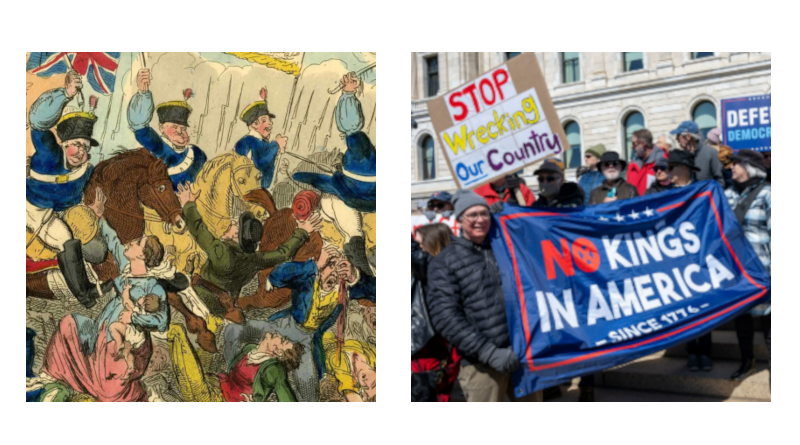
Instead, magistrates ordered Hunt's arrest and sent in the Yeomanry. Cavalry charged into the densely packed crowd. At least 18 people were killed and hundreds injured.
The massacre shocked Britain.
Yet Peterloo's lasting significance lies in the nature of the assembly before the violence. It marked one of Britain's first modern, mass, organised, peaceful political reform rallies.
It was not spontaneous unrest.
It was structured civic pressure.
Peterloo did not deliver immediate reform. The government responded with the Six Acts, tightening restrictions on public meetings and radical publications.
But the practice of gathering endured.
Within two decades, the Chartist movement organised some of the largest political rallies Britain had yet seen. Between 1838 - 1848, Chartists submitted mass petitions demanding universal male suffrage, secret ballots, and payment for MPs. One petition claimed more than three million signatures.
The method was deliberate: organise locally, gather nationally, count the numbers.
If Parliament would not represent working people, working people would represent themselves.
By the early 20th century, women's suffrage groups adopted similar tactics. Large, disciplined marches moved through London and other cities. Banners made demands public. When petitions failed, civil disobedience followed.
Across the Atlantic, the same logic shaped the civil rights movement. In 1963, more than 250,000 people gathered in Washington, D.C., for the March on Washington for Jobs and Freedom.
Martin Luther King Jr told the crowd:
“We cannot walk alone.”
The crowd was not symbolic background. It was proof of collective demand.
Frederick Douglass had expressed the principle decades earlier:
“Power concedes nothing without a demand. It never did and it never will.”
Crowds make demands visible. They show who stands together and who has been excluded.
They force a basic democratic question: who gets counted?
Looking across these movements, certain features recur:
At Peterloo, reform societies rehearsed their formations. Chartists coordinated petitions town by town. Suffrage groups planned disciplined marches. Civil rights organisers mobilised churches and community networks.
Public assembly is rarely accidental. It is organised.
And it has often been treated with suspicion.
Authorities in 1819 feared large gatherings would tip into riot. Governments in later decades voiced similar concerns. Crowd control became a recurring political issue.
Yet over time, disciplined mass protest came to be recognised as a legitimate democratic tool rather than a threat to order.
In June 2025, demonstrations took place across the United States under the banner ‘No Kings Day'.
Protests were held in more than 2,000 towns and cities across all 50 states. Major gatherings took place in Philadelphia, Denver, Minneapolis, Phoenix, and Los Angeles, alongside hundreds of smaller community rallies. Organisers estimated participation in the millions.
The demonstrations responded to concerns about executive overreach and the expanding use of presidential authority. Many participants connected their presence to debates about voting rights, protest law, and the role of federal power ahead of the 250th anniversary of American independence in 2026.
The tools were modern. Social media replaced broadsides. Encrypted messaging replaced committee rooms. Handmade placards replaced embroidered banners.
The structure was familiar: assemble visibly, demonstrate numbers, articulate demands.
As one young protester in Philadelphia said:
“Democracy is not a spectator sport.”
The language has changed. The principle has not.
In 1819, reformers marched in disciplined columns.
In 2025, organisers coordinate through encrypted apps.
In 1819, banners declared reform in bold lettering.
In 2025, cardboard signs carry printed slogans and QR codes linking to petitions.
The materials evolve. The method remains.
Public assembly signals that political demands are shared, not isolated.
Peterloo marked a shift from riot to organised reform rally. That shift travelled through Chartism, suffrage, civil rights, and into the present.
Crowds do not replace democracy.
They reveal whether it is working.
When people gather in public squares, they are not abandoning tradition.
They are continuing one.
The long tradition of crowd power is not about disruption for its own sake.
It is about citizens insisting that democracy respond.
And that insistence has echoed since 1819.
Rooted in Quaker radical faith & activism, YQN empowers young adults to explore Quakerism, challenge injustice, and build a more peaceful future through friendship.