
| | by admin | | posted on 18th December 2025 in Quakers Through the Ages | | views 92 | |
How Quaker beliefs, governance, and conscience shaped colonial America, collided with revolution, and left a lasting ethical legacy in the United States.
Throughout this article, the term American Revolution is used deliberately. It refers not only to the years of armed conflict, but to the wider period of political, social, and moral transformation that reshaped colonial America from the 1760s through the early decades of the new republic.
The American Revolutionary War describes the military struggle itself, fought between 1775 and 1783. While that war forms part of the story, it does not fully capture the experiences of those who opposed violence, refused military participation, or engaged with the revolution primarily through conscience, governance, and civic life.
For Quakers, this distinction matters. Their history during this period cannot be understood solely through battles and campaigns, but through the pressures placed on belief, neutrality, and moral consistency within a rapidly changing society. Using American Revolution allows space for those quieter forms of participation and resistance.
Quaker involvement in what became the United States began long before the American Revolution. From the late seventeenth century, Friends established strong communities across several colonies, most notably in Pennsylvania, New Jersey, Delaware, Rhode Island, and parts of North Carolina. These communities were not marginal religious enclaves but central participants in colonial civic life.
The clearest expression of early Quaker political thought was William Penn’s founding of Pennsylvania in the 1680s. Penn envisioned the colony as both a refuge from religious persecution and a practical experiment in ethical government. His Frame of Government introduced representative assemblies, limits on executive authority, protection of liberty of conscience, and the principle that government derived its legitimacy from the consent of the governed.
Over successive revisions, the Frame became a living constitutional system. By the early eighteenth century, its assumptions had shaped Pennsylvania’s political culture, embedding ideas of restraint, tolerance, and accountability that would later influence revolutionary debate.
By the mid eighteenth century, Quakers were firmly committed to a set of religious testimonies that included peace, refusal of oaths, and opposition to violence. These were not abstract principles but disciplines enforced through Quaker meetings and communal accountability.
As tensions with Britain escalated after 1763, Friends faced increasing pressure from all sides. Imperial authorities demanded loyalty and compliance, while revolutionary leaders called for resistance, taxation, and military organisation. For most Quakers, neither position could be accepted without violating conscience.
The crucial Quaker stance was opposition to war itself, not allegiance to either crown or rebellion. This distinction was often misunderstood by neighbours, leading to accusations of disloyalty that would intensify as conflict approached.
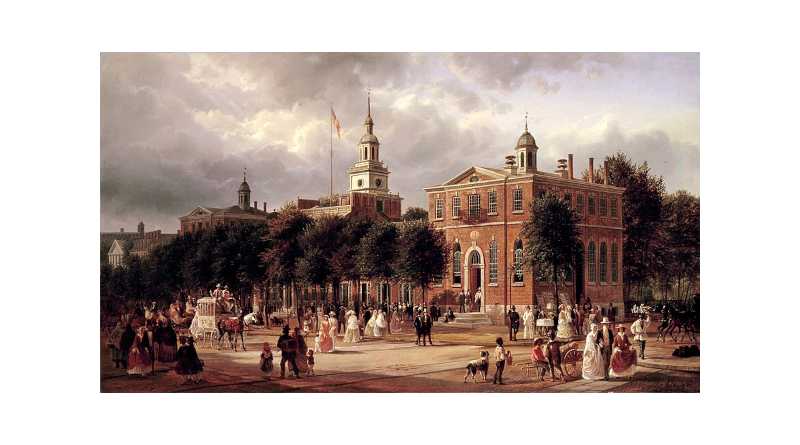
Philadelphia stood at the centre of this unfolding crisis. For nearly a century it had been governed under political systems rooted in Penn’s original charter, and Quakers had long played prominent roles in civic administration.
By the early 1770s, however, this influence was rapidly eroding. Quakers were pressured out of public office, voting rights became linked to loyalty oaths they could not swear, and refusal to support militia funding brought suspicion and hostility.
Figures such as Benjamin Franklin, though not Quakers themselves, operated within a political world shaped by Quaker norms. Franklin worked pragmatically with Quaker leaders while increasingly advocating defence and preparedness, illustrating the growing distance between pacifist principles and revolutionary realities.
The outbreak of war fractured the Society of Friends. While the majority of Quakers maintained neutrality and refused participation in the conflict, a minority supported the revolutionary cause. Some joined militias, paid war taxes, or aided independence in other ways.
Quaker meetings responded by disowning members who violated the peace testimony. In response, the Religious Society of Free Quakers was formed in Philadelphia in 1781. Its members sought to preserve Quaker worship and identity while openly supporting American independence.
The Free Quaker meetinghouse at Fifth and Arch Streets remains a physical reminder of this division. Individuals associated with the Free Quakers included Betsy Ross, whose Quaker background and revolutionary associations reflect the overlapping personal, religious, and political loyalties of wartime Philadelphia.
Thomas Paine embodies many of the tensions Quakers faced during the Revolution. Born in England in 1737 to a Quaker father, Paine was raised within a Quaker household and absorbed its moral plainness, suspicion of hierarchy, and emphasis on individual conscience.
As an adult, Paine rejected organised religion in favour of deism and came to support armed revolution. In writings such as Common Sense, he criticised Quakers for refusing to support the war effort, viewing pacifism as impractical during a national crisis.
Yet Paine’s relationship with Quakerism remained unresolved. When he died in 1809, he requested burial as a Quaker but was refused due to his beliefs and writings. His life reflects a revolutionary break from Quaker discipline, while still bearing the imprint of Quaker moral formation.
The Declaration of Independence was debated and adopted in Philadelphia in July 1776, in a city long shaped by Quaker governance but now dominated by revolutionary politics. Quakers did not support the Declaration as a body, and many opposed it as an endorsement of war.
Nevertheless, the Declaration emerged from a political culture influenced by William Penn’s constitutional experiment. The idea that governments derive their authority from the consent of the governed had been lived reality in Pennsylvania for decades under systems descending from the Frame of Government.
Penn’s influence on the Declaration was structural rather than textual. While Enlightenment philosophy supplied much of the Declaration’s language, Pennsylvania’s Quaker-founded institutions demonstrated that constitutional limits, representative government, and liberty of conscience could function in practice.
Throughout the war, Quakers paid a heavy price for maintaining neutrality. Many were fined, imprisoned, exiled, or had property confiscated. Others lost voting rights or social standing as loyalty to the revolutionary cause became a requirement for civic participation.
Their refusal to fight was frequently interpreted as sympathy for Britain, despite consistent opposition to violence on all sides. These experiences left lasting scars within Quaker meetings and reinforced a collective retreat from political power.
The American Revolution marked a decisive turning point in Quaker history. In its aftermath, Friends largely withdrew from formal political authority, not because their ideals had failed, but because participation increasingly required compromise with violence, coercion, and oath-taking.
This retreat from governance reshaped Quaker identity. Freed from the demands of state power, Quakers redirected their energies toward moral witness and social reform. The disciplines tested during the Revolution became the foundation for sustained engagement with injustice rather than episodic political control.
In the decades following independence, Quakers emerged as leading voices in abolitionism, prison reform, education, Indigenous rights advocacy, and humanitarian relief. Their credibility in these movements rested partly on the moral consistency they had maintained during the war, even when that stance proved costly.
The Revolution also left a deeper legacy. It exposed the tension between liberty achieved through violence and liberty grounded in conscience. Quakers lived inside that contradiction, helping to shape the political culture that made independence possible while refusing to sanctify war as a moral good.
In this sense, the Quaker legacy of the American Revolution is not one of triumph or defeat, but of endurance. Their witness reminds us that the struggle for freedom does not end with independence, and that the hardest victories are often those won without weapons.