| | by admin | | posted on 3rd December 2023 in Quakers in 100 Objects | | views 2791 | |
Mary Dyer (c. 1611 – 1660) was an English Quaker who was hanged in Boston, Massachusetts, for her beliefs.
Dyer and her husband William were married in 1633, England, and both were outspoken Puritans. As such they faced persecution and, like many others, decided to travel to the American colonies to find a new life and religious freedom.
In 1635, they arrived at Boston and joined the church in the Massachusetts Bay Colony. But, before the couple could settle, they were caught up in the religious and political conflict known as the Antinomian Controversy.
The Antinomian Controversy saw the colony’s leaders argue with settlers about the religious direction the Massachusetts Bay Colony should take. Simply put, the leaders wanted to enforce the strict version of English Puritanism according to their interpretation of the bible and many settlers wanted more freedom.
Mary and William supported Ann Hutchinson, the woman who led the rebellious settlers. As such they were all labelled heretics and forced to leave the colony and set up a new colony in Rhode Island.
But, before they left Boston, Mary’s third pregnancy ended in the premature stillbirth of a girl with anencephaly (having only a brain stem) and spina bifida deformities. The birth was briefly kept hidden, as in the 17th century such physical deformity in a newborn child was a sign of ‘monstrous’ beliefs.
Six months after the newborn baby was buried, Governor John Winthrop, who founded the Massachusetts Bay Colony, ordered the exhumation and examination of the baby’s body in front of a large crowd. He compared it to the devil and proof of God’s judgment on Mary’s supposed heresy.
Having been exiled to Rhode Island, in 1652 Mary and William went back to England and visited Swathmoor Hall, Cumbria, where they became Quakers – having met Margaret Fell and possibly George Fox as well.
Five years later, in 1657, the couple returned to Boston despite being banished from the colony. Mary was banished again and the Massachusetts Bay Colony passed a law the following year that any Quakers found within its borders could be punished upon pain of death.
Despite the new law, Mary came back, determined to speak out for religious freedom. Refusing to leave the colony along with two other Quakers, William Robinson and Marmaduke Stephenson, all three were sent to death.
The date set for the executions of the three Quakers was 27 October 1659. Dyer walked hand-in-hand with the two men as they were led to the gallows, which was nothing more than an elm tree with a ladder and rope.
Robinson and Stephen were hanged from the tree, but when it came to Mary’s turn, a letter of reprieve was handed to the court in charge of the executions. The letter was a petition obtained by her son to spare Mary’s life if she agreed to leave the colony once again.
Mary was taken down from the elm tree gallows and given time to leave the colony. However, the day after she was pulled from the gallows, Mary wrote a letter to the court refusing to accept the terms of the reprieve:
“My life is not accepted, neither availeth me, in comparison with the lives and liberty of the Truth and Servants of the living God for which in the Bowels of Love and Meekness I sought you; yet nevertheless with wicked Hands have you put two of them to Death, which makes me to feel that the Mercies of the Wicked is cruelty; I rather chuse to Dye than to live, as from you, as Guilty of their Innocent Blood.”
Mary then chose to leave the colony, under her own freewill, to go back to Rhode Island. But she returned to Boston on 21 May 1660 and ten days later she was once again brought before the governor. Again, Dyer refused to repent and was taken to the elm tree gallows. Her last words were:
“Nay, I came to keep bloodguiltiness from you, desireing you to repeal the unrighteous and unjust law made against the innocent servants of the Lord. Nay, man, I am not now to repent.”
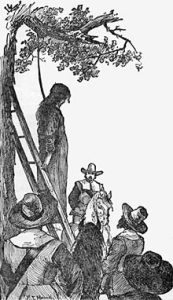
Dyer was hanged and buried in an unmarked plot. After her death, a member of the court in charge of the executions, Humphrey Atherton is reputed to have said “she did hang as a flag for others to take example by”.
A fourth Quaker from the colony, William Leddra of Barbados, was later hanged on 14 March 1661 for his religious beliefs.
Remorse over these unnecessary executions, especially that of Dyer, led to a lessening of anti-Quaker laws across the colonies. The Rhode Island Royal Charter of 1663, legally granted freedom of religion to its people, which was subsequently adopted in various forms across the colonies.
In memory of the Quaker executions, October 27 (the date of the first two hangings) is now International Religious Freedom Day – to recognize the importance of freedom of religion.
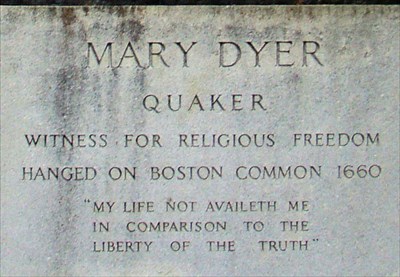
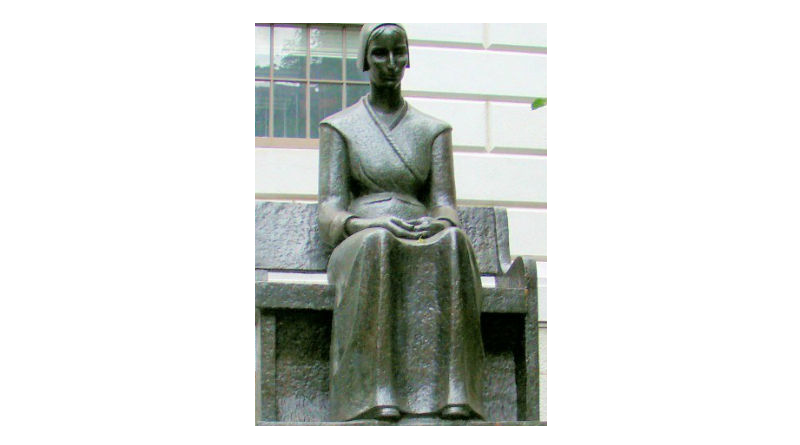
Today, a statue of Mary Dyer stands in Boston Common, where her life famously ended. The 1959 bronze statue of Dyer is by Quaker sculptor Sylvia Shaw Judson and it stands in front of the Massachusetts State House in Boston. A copy of the statue is in Philadelphia, Pennsylvania and another copy in Richmond, Ohio.